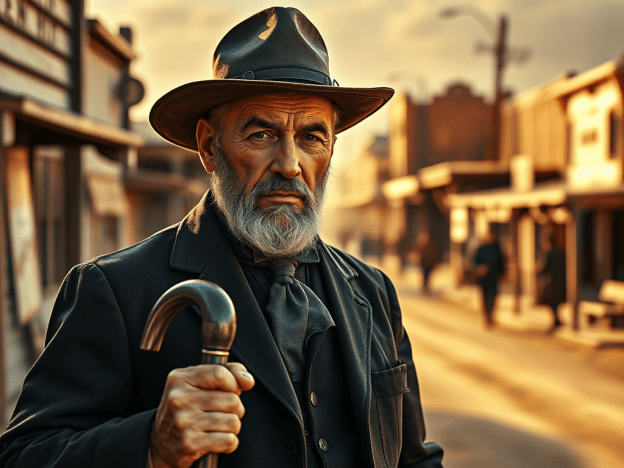
In 1873, Bakersfield was officially incorporated. The town had grown quickly, with migrants from all over looking to make their fortune. The land was dry, but opportunity flowed like water. By 1874, Bakersfield replaced the nearby town of Havilah as the county seat. This shift of power didn’t sit well with some, but the oil fields and farmlands demanded it. Bakersfield was becoming something more. The city’s leaders decided they needed a marshal to keep order. They chose Alexander Mills.
Mills was from Kentucky, a man who had seen the world change. He walked with a cane, and some said he should have retired long before Bakersfield hired him. But Mills had a steady hand with a gun and a reputation for getting things done. Some liked him for his grit, others feared him for his temper. He was known to be high-handed with the local businessmen, often treating them as if they were criminals. As time went on, the resentment grew.
By 1876, the city was struggling. It couldn’t collect the taxes it needed to provide services, and the businessmen wanted Mills gone. But no one dared confront him directly. Instead, they came up with a plan. They would vote to disincorporate the city. Without a city, Mills would have no job, no authority. It worked. Bakersfield disincorporated, and Mills was left with nothing. For the next 22 years, a council of citizens managed the town.
But Bakersfield wasn’t done. By 1880, the town had a population of 801, including 250 Chinese laborers. The railroads and the oil industry brought new faces, new money. People came from Texas, Louisiana, Oklahoma, and Southern California, all looking for work. By 1890, the population had swelled to over 2,600. Bakersfield reincorporated on January 11, 1898. The town was back, and it was bigger than ever.
In the late 1890s, a woman named Eliza Harper lived in Bakersfield. She was known for her quiet demeanor, but she was sharper than most people realized. Eliza ran a small shop on Main Street, selling dry goods to the townspeople. She kept to herself, but she saw and heard everything that happened in Bakersfield.
One evening, Eliza was closing her shop when a young man burst through the door. He was frantic, sweating, and out of breath. “Miss Harper,” he said, “they’re going to hang me for a crime I didn’t commit.”
Eliza had heard about the crime. A local rancher had been murdered, and the sheriff had rounded up a suspect—this young man. The evidence was thin, but the town was angry. Someone had to pay. Eliza looked the man over. His clothes were torn, his face bruised. “Why should I believe you?” she asked.
“Because I wasn’t there,” he said. “I was with someone that night. But she’s scared to speak.”
Eliza thought for a moment. “Who is she?” she asked.
The young man hesitated. “Her name’s Sarah. She works at the saloon.”
Eliza nodded. She knew Sarah, a quiet girl who kept to herself, much like Eliza. The next morning, Eliza went to the saloon. Sarah was sweeping the floor when Eliza walked in. “We need to talk,” Eliza said.
Sarah looked up, her eyes wide with fear. “I can’t,” she whispered. “They’ll kill me if I speak.”
Eliza stepped closer. “If you don’t, an innocent man will die.”
Sarah hesitated, then nodded. She told Eliza what she knew. On the night of the murder, the young man had been with her at the saloon. He couldn’t have killed the rancher. But the real killer, Sarah said, was someone powerful in town, someone who had threatened her to stay silent.
Eliza knew what she had to do. She went straight to the sheriff. At first, he didn’t believe her. But Eliza was persistent. She told him about Sarah, about the threats, and finally, the sheriff agreed to investigate. It wasn’t long before the real killer was found—a local businessman who had a dispute with the rancher over land.
The town was shocked. They had been ready to hang the wrong man. The sheriff arrested the businessman, and the young man was freed. The townspeople were grateful to Eliza, though she didn’t ask for thanks. She went back to her shop, content to fade into the background again.
Years later, people still talked about how Eliza Harper had saved that young man’s life. But there was something Eliza never told anyone. She had known all along who the killer was. She had seen him arguing with the rancher days before the murder. But she had waited. She had wanted to see if Sarah would find her courage.
In the end, Eliza had been right to wait. The truth had come out, and Sarah had spoken up. But Eliza knew that without her quiet push, nothing would have changed. Sometimes, she thought, it’s not about what you know, but what you let others discover on their own.
 Motivation E-Books