Alice Springs, in the Northern Territory began as a small, isolated town.
Its people were hardy folk, used to the heat and the dry air. In 1954, Americans arrived. Not as tourists, but as residents.
Their base was set up outside of town as part of a joint American-Australian agreement. This brought American families into the heart of the desert, and slowly, Alice Springs began to change.
New customs arrived with them. Thanksgiving dinners became as familiar as Australian meat pies. Baseball games replaced cricket on weekends.
The children of Alice Springs grew up playing both sports, celebrating both the 4th of July and Australia Day.
By the 1970s, Alice Springs had transformed.
Pine Gap, the satellite tracking station southwest of town, brought in more Americans and jobs.
The town expanded. It was no longer just a remote outpost in the desert.
It had become an international community where Australian and American families lived side by side.
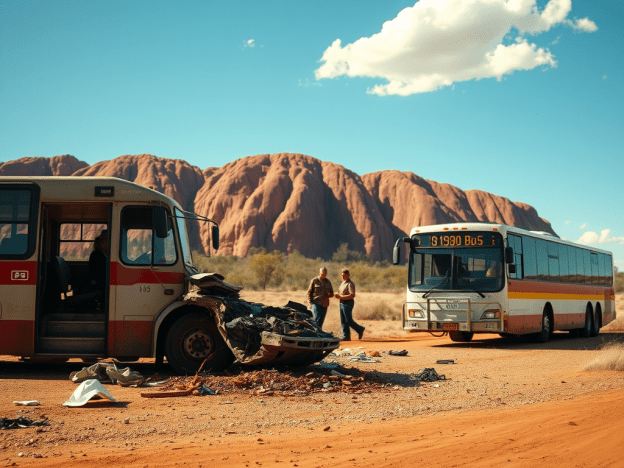
One American family lost their son in a crash with a bus.
The son and his friends were bored, so they decided to drive to Ayers Rock.
A tourist bus was coming in the opposite direction.
The bus driver took a corner too wide and hit the car.
The Grief of a Family
Judy sat at the kitchen table, staring at a photograph.
It had been two years since the crash. Her son, Adam, had been full of life.
Eighteen, with the world at his feet.
He had plans, dreams, things he wanted to do.
But all of that ended one rainy afternoon.
The bus had come around the corner too fast. It skidded, losing control, and smashed into Adam’s car.
The bus driver was at fault. The investigation said as much, but nothing happened.
He still walked the streets of Alice Springs.
Judy saw him at the market, at the post office.
Free, while her son was gone.
Her husband, Henry, couldn’t bear to look at the man.
Every time he saw him, rage bubbled up inside him, threatening to explode.
He’d grip Judy’s hand, tighter than he needed to, but she never said anything.
She understood.
One afternoon, they were sitting at the café.
Judy saw the bus driver again, walking down the street, laughing with a friend.
She watched Henry’s face harden. His fists clenched.
“He should be in jail,” Henry muttered.
Judy didn’t answer right away. She sipped her tea, looking out over the town square. “What would it change?”
“He’s walking free while our son is in the ground.” Henry’s voice was low, filled with pain.
“I know.” Judy placed her hand on his. “But anger won’t bring Adam back.”
Henry looked away, his jaw tight. “Then what will?”
There was no answer to that. Not one that made sense.
They had been asking themselves that question for two years. And in all that time, nothing had filled the emptiness that Adam left behind.
Weeks passed, and the town grew restless. People whispered about the tension between Henry and the bus driver. There were looks exchanged, and rumors spread. Some said Henry would confront the man. Others feared worse.
Judy sat down with Henry one evening. They were in their living room, the lights dim, the house quiet. She looked at him, really looked at him, and saw the weight he carried.
“I can’t live like this anymore,” she said softly. “It’s tearing you apart. It’s tearing us apart.”
Henry didn’t respond. He stared at the floor, his shoulders hunched.
“I’ve been thinking,” Judy continued. “We need to make peace.
Not for him,” she added quickly, “but for us.”
Henry scoffed. “Peace? How?
He’s still out there. Every time I see him, I want to kill him”
“I know,” Judy interrupted. “But we can’t keep living in anger. It’s killing us.
We need to move forward.”
Henry shook his head. “I can’t forgive him.”
“I’m not asking you to.” Judy’s voice was calm, steady.
“But we need to find a way to let go. For Adam’s sake.”
That struck a chord. Henry sat back, his eyes glistening.
“For Adam,” he repeated, his voice barely a whisper.
Judy reached out and took his hand. “I’ll make you a bargain,” she said.
“We’ll try. We’ll do it together. But if it’s too much, we’ll walk away.
No shame. But we have to try.”
Henry nodded, though reluctantly. “Alright,” he said after a long pause. “For Adam.”
Months later, Judy was in the town square when she saw the bus driver again.
But this time, he wasn’t laughing. He was handing out fliers, speaking quietly to a small group of people.
Curious, she approached.
The flier in his hand read: “A Memorial Fund for Adam”.
The bus driver caught her eye, and for the first time, his expression wasn’t one of indifference. It was sorrow.
“I did the wrong thing,” he said quietly.
“But maybe I can do the right thing and help others.”
Judy stood there, surprised, not knowing what to say.
The anger she had held onto for so long suddenly seemed lighter.
Maybe, just maybe, there was a way forward after all.
 Motivation E-Books