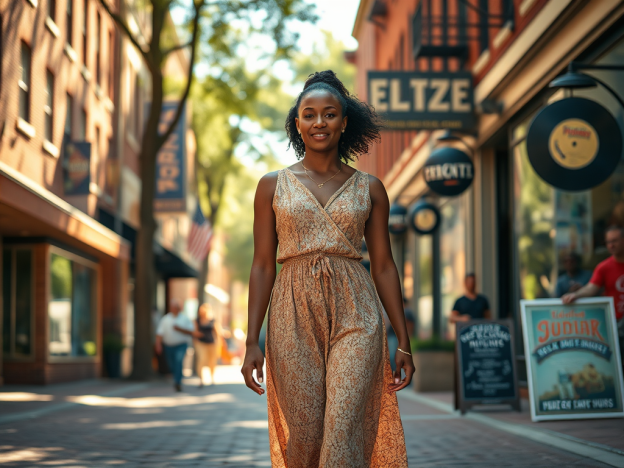
Macon, Georgia, founded in the early 19th century, grew as a trade hub along the Fall Line, where the Piedmont met the Coastal Plain. Cotton thrived in its red clay soil, and the city’s warehouses were bustling. By the mid-1800s, Macon had become a cornerstone of the Southern economy. Its streets were lined with buildings reflecting its wealth—brick facades that have stood for generations.
In the 1830s, the construction of Ocmulgee Mounds Park began. The site’s ancient history was a point of fascination. Though many were aware of the forced displacement of the area’s Indigenous people, this history often faded into the background as the city expanded.
The Civil War brought strife. Macon, spared from General Sherman’s burning path, became a refuge. Post-war reconstruction ushered in a wave of industrial growth. Black-owned businesses thrived in areas like Cotton Avenue. But by the 20th century, segregation and economic shifts created divides. Cotton markets faltered; music filled the void. Artists like Otis Redding and Little Richard emerged, their soulful sounds echoing through Macon’s streets. By the 2000s, the city had begun revitalizing itself, leveraging its musical legacy and historical significance.
In July of 2024, the town buzzed with more than its usual energy. Eliza, a 21-year-old known for her stoic demeanor, drew attention. She had been born with a congenital limp. The slow, uneven gait defined her movements and her role in the town. Many admired her determination, while others pitied her struggle. Eliza worked at a small music store, organizing records and greeting tourists who came to see the city’s landmarks.
One day, Eliza disappeared from her usual spot. Her absence lasted for three days. When she returned, she walked differently. Her limp was gone. At first, only a few noticed. “Eliza, you seem… different,” said Mrs. Carter, a regular customer. Eliza’s response was simple: “Yes. I am.”
Word spread quickly. Some townsfolk were ecstatic. “A miracle,” declared Mr. Howard, the church deacon. “She’s been healed.”
Others were skeptical. “It’s a trick,” muttered a man at the bar. “People don’t just change like that.”
When pressed for answers, Eliza spoke cryptically. “I prayed differently,” she said. “It’s not something I can explain.”
The ambiguity only fueled speculation. Some believed she’d found divine favor. Others thought she’d undergone a secret surgery. The debate engulfed the town. CNN ran a short segment on the story, showcasing the split opinions. Macon’s streets, alive with history, now buzzed with arguments over Eliza’s transformation.
“You need to tell us how,” said Pastor Garrison during a Sunday service. “If it’s God’s work, the world should know.”
Eliza attended the service but said little. Her presence alone stirred unease. “Faith isn’t for display,” she finally said. Her words silenced the congregation.
Privately, Eliza kept a journal. In it, she recorded her prayers—structured sentences repeated at dawn and dusk. She’d found the method in an old book about ancient meditation techniques and hymns she’d grown up singing. It was her secret. She told no one, believing the practice would lose its power if shared.
One evening, Eliza visited the Ocmulgee Mounds. She walked the trails, feeling the weight of the earth beneath her feet. She knelt on the grass, her palms up. “Show me the way,” she whispered. To her, this was her true prayer—a connection to God, something beyond understanding.
The city’s divide grew. At a town hall meeting, Mayor Thompson addressed the issue. “We’re a community,” he said. “We celebrate each other’s triumphs. Let’s not tear ourselves apart over something we don’t fully understand.”
But the tension remained. Tourists began arriving, hoping to catch a glimpse of Eliza. Some sought blessings. Others wanted answers. “She’s hiding something,” accused a man from Atlanta who’d driven down just to see her.
The plot thickened when Dr. Morgan, a local physician, claimed she’d examined Eliza years ago. “Her condition was irreversible,” she said. “This defies everything I know about medicine.”
Eliza’s closest friend, Daniel, visited her one evening. “They won’t stop,” he said. “You’ve got to give them something.”
“I’ve given them all I can,” Eliza replied. Her tone was firm.
Daniel frowned. “Do you even know how this happened?”
“I prayed,” Eliza said again. “And I believed.”
As the month wore on, the community’s fascination began to wane. The bagel shop and the soul food restaurant drew crowds again. The music halls filled with laughter and song. Eliza continued her work at the music store, her steps steady.
In the final days of July, a letter arrived for Eliza. It bore no return address. Inside was a single sentence: “You walk because you let go.”
Eliza read it twice and tucked it into her journal. She knew the words were true. It wasn’t the prayers or the method. It was the act of releasing her fear and accepting the unknown. Her secret wasn’t in the prayer itself but in the shift it caused within her.
The surprise came not in Eliza’s transformation but in its ripple effect. Quietly, others in the town began to change. Small miracles unfolded. A man with chronic pain felt relief. A woman who’d been estranged from her sister made amends. People spoke more kindly. The community’s division over Eliza faded, replaced by something unspoken yet shared.
Eliza’s story became less about her and more about Macon—a town reconciling its past, finding healing in its present.
 Motivation E-Books