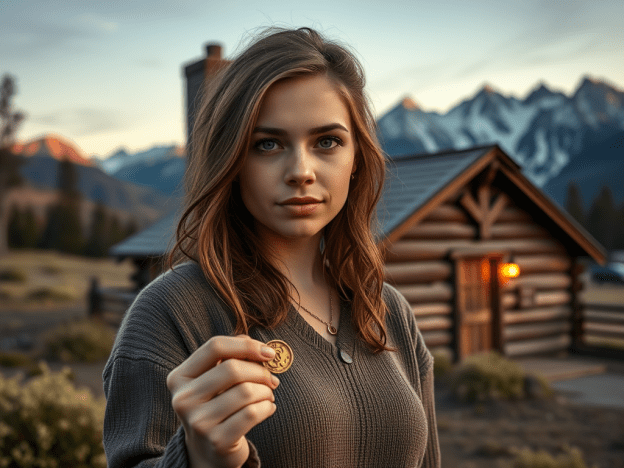
Republic, a small town in Northeast Washington, began as Eureka Gulch in the 1890s. Back then, the land was rich with gold and timber, drawing miners and loggers. They built rough-hewn cabins, narrow streets, and saloons that never seemed to close. By 1900, the town had changed its name to Republic, reflecting the independent spirit of its people.
The heart of Republic became its architectural landmarks. Kaufman Cabin, built in 1896, still stands, a reminder of the town’s rugged beginnings. The Republic Cemetery offers sweeping views of the valley, the Sanpoil River, and the Kettle Range. The landscape has always shaped the people who live there—practical, resilient, and deeply tied to the land.
Amidst this history, a young woman named Vicki Dunn made her mark one summer. Vicki had grown up in Republic, the daughter of a stern but kind father, Henry Dunn, who was known for his collection of old coins. Henry had a sharp eye for detail and a deep respect for history. His coins, neatly stored in velvet-lined boxes, were his pride and joy.
Vicki, restless in the slow rhythm of small-town life, decided to leave for Spokane one July. She carried a small part of her father’s coin collection with her, hoping to sell it online. Henry had reluctantly agreed, his words lingering in her mind: “Coins hold stories, Vicki. Don’t sell the wrong ones.”
In Spokane, Vicki rented a tiny room and listed the coins on eBay. At first, sales were slow, but soon, interest grew. Collectors messaged her with offers, questions, and stories about their own collections. Vicki found the work tedious. She missed the familiar streets of Republic, the cool air of the Kettle Range, and the sound of the Sanpoil River. At night, she dreamed of her family. In one dream, her father’s voice echoed: “Not all coins are for selling, Vicki. Some hold more than value.”
After two weeks, Vicki’s dreams grew vivid and unsettling. She saw her father’s weathered hands, her mother’s quiet smile, and her younger brother, Leo, staring at an empty table. She woke up one night with a decision: she would go back. The coins, the city, and the online marketplace felt hollow compared to the pull of home.
Vicki’s return to Republic wasn’t as she expected. Her mother hugged her tightly. Leo grinned and asked her about Spokane. Henry, however, stood silent. “Did you bring back what’s left?” he asked.
“Yes, Dad,” Vicki said, handing him the unsold coins. “But I sold some. I… I needed to try.”
Henry nodded but said nothing. The family gathered for dinner that night, the air thick with unspoken words. Vicki explained her dreams and how they had drawn her home.
“Dreams are tricky,” Leo said. “They’re not always about what you think.”
Henry spoke finally. “What did you learn, Vicki?”
Vicki thought for a moment. “That it’s not just about selling. Coins are more than money. They’re a part of something bigger.”
“Good,” Henry said. “Then you understand.”
The family’s conversations grew warmer over the following days, but Vicki sensed an unease in her father. One evening, Henry revealed a secret. Among the coins Vicki had sold was a rare piece—a 1794 silver dollar. It wasn’t just valuable; it had been given to Henry by his own father.
“I should’ve told you,” Henry admitted. “But I wanted you to learn. Now, we’ll have to find it again.”
Vicki felt a pang of guilt but also determination. She contacted the buyer, a collector named Victor, who lived in Seattle. Vicki explained the coin’s significance and offered to buy it back. Victor, intrigued, agreed to meet.
Vicki and Henry made the journey to Seattle. Victor was a soft-spoken man with a passion for history. “This coin is special,” he said. “I’d planned to keep it, but your story changes things.”
Victor returned the coin without accepting payment. “Sometimes, history needs to stay where it belongs,” he said.
Back in Republic, Vicki and Henry decided to start a new project. Together, they created a small museum in town, showcasing the coin collection and other artifacts from Republic’s past. They called it the Spirit of Republic Museum, a place to preserve the town’s history and share its stories with others.
Visitors came, drawn by the exhibits and the tales Vicki and Henry shared. The museum became an architectural landmark in its own right, a symbol of the town’s enduring spirit. Vicki’s month-long journey had brought her back to her roots, with a deeper understanding of her family and the place they called home.
 Motivation E-Books