Category Archives: disability

Gloria Estefan’s Core Transformation

To seek a life that registers as a 10 out of 10 is to chase a state of internal completeness, where external success is fully aligned with an unshakeable inner purpose. It is a quest to master the existing cycle and claim the power of a new beginning. For Gloria Estefan, the globally iconic singer and entrepreneur raised and based in Miami, Florida, her path to this mastery was forged not on a concert stage, but in the traumatic, silencing stillness of a hospital bed following a near-fatal accident.

Estefan’s initial, hugely successful career with the Miami Sound Machine was a life that, to the outside world, already registered as a shimmering 9 out of 10. She had achieved every metric of success: global fame, immense wealth, cultural impact, and a dedicated family. However, on an internal and existential scale, this life was fundamentally a high-stakes, brittle 6 out of 10. It was a life built on a relentless sequence of performance, promotion, and perfectionism. The very foundation of her success was her physical stamina, her voice, and the public’s constant, fluctuating approval.

The reason her life, despite its brilliance, remained in this precarious middle range was her foundational belief: she operated under the professional constraint that her value was directly proportional to her ability to produce and perform. Her energy was relentlessly focused outward—on the next tour, the next album, the next chart position. She believed the music had to continue without pause; that the momentum of the sequence (0 through 9) could never be broken. This created a profound, unspoken dependence on the continuity of her external environment, leaving her vulnerable and defined by her labor rather than her essence. She was a master of her craft but had not yet mastered the cycle of fear and self-constraint that accompanied such demanding celebrity.

This cycle came to a violent, immediate end on March 20, 1990, when her tour bus was rear-ended by a tractor-trailer during a snowstorm in Pennsylvania. The impact shattered her vertebrae, halting her life and career instantly. Her physical body, the engine of her 6/10 life, was temporarily broken, raising the prospect of permanent paralysis. The life she had known was over. This was the moment where the count stopped, forcing her to confront the silence at the end of the sequence, signaling an absolute conclusion.

The long, agonizing recovery that followed, characterized by an intrusive surgical procedure and months of demanding physical therapy, was the crucible in which her core belief was radically reformed. Trapped away from the spotlight, she was stripped of the very things that had previously defined her—her movement, her schedule, her ability to perform. It forced her to look inward and grapple with the possibility that she might never return to the stage.

Her profound shift was the realization that her life’s purpose was not performance; it was resilience. Her new guiding belief emerged: “My purpose is rooted in internal strength, emotional connection, and my proven capacity to endure, which I can manifest through my art, regardless of my physical limitations.” This was the radical shift toward the 10 out of 10 mindset. She traded the necessity of perfection for the authenticity of struggle. She learned that the true power of completeness was already inside her, unshakeable by external forces.

This was the start of her new beginning. When she returned to public life a year later with the album Into the Light and the deeply personal ballad “Coming Out of the Dark,” she was an entirely different icon. She was no longer just a performer chasing hits; she was a symbol of human triumph over trauma. The audience who received her was not merely applauding a singer, but celebrating a shared, profound human experience of endurance.

By grounding herself in this new understanding, Gloria Estefan fully embraced the Foundation of 10. Her music became richer, her business ventures (including restaurants, hotels, and a Broadway show) became extensions of her personal narrative, and her life attained a profound, unassailable depth. She had transformed from a highly successful but fragile 6/10 existence—vulnerable to the whims of her body and the public—into an exemplar of lasting, purposeful excellence. Her transformation proved that sometimes, the greatest external success is only made possible by surviving a catastrophic internal end and emerging with an entirely new, unconstrained core belief.

Motivation Post and Books

Free Motivation Book

A short encouragement to motivate you for free.

New Level of Motivation

Would you like to go to a new level of motivation?

A Book about Success

A longer book to explore your inner potential.
Back to Home Page

Healing Miracles in Des Moines: A Night of Faith

In the heart of Iowa, in the vibrant city of Des Moines, a remarkable healing meeting took place, led by a woman named Stella. As the state’s beating heart, Des Moines is known for its economy, politics, culture, and nightlife. However, on this particular evening, it became the epicenter of faith and divine healing.

Stella, a passionate and devoted believer, organized the gathering in one of the city’s well-known community halls. People from across Des Moines and beyond, even from cities like Chicago, Kansas City, Minneapolis, and Omaha, made the journey to attend. The word had spread about the miracles that often accompanied Stella’s meetings, and there was a palpable sense of anticipation in the air.

As attendees filled the hall, Stella took the stage with a warm, confident presence. She began by reminding everyone of the power of faith and the certainty of God’s will in healing. “We don’t serve a God of uncertainty,” she declared. “He has already made His will known. He is the God of healing, of restoration, and of miracles.”

The meeting commenced with fervent prayer, as hands were laid on those in need. Stella cited Mark 16:18, emphasizing that believers are called to place their hands on the sick so they may recover. “Jesus didn’t say this was only for pastors or preachers. He said this was for believers! Are you a believer? Do you have hands? Then you, too, can be an instrument of healing!” she proclaimed.

One by one, people stepped forward to receive prayer. A man with chronic back pain stood in faith as Stella placed her hands on him, declaring his healing in the name of Jesus. “Healing is not about what we see or feel at the moment,” she said. “It is about standing firm on God’s Word and believing in His promise.”

Another woman, a mother of three, approached the front with tears in her eyes. She had been battling an illness for years, with no improvement. As Stella prayed for her, the atmosphere was thick with faith. “By His stripes, you are healed!” Stella affirmed, and the woman collapsed to her knees in gratitude and praise.

The meeting continued late into the night, with testimonies of healing unfolding before everyone’s eyes. People were reminded of Jesus’ ministry, where He touched the sick and they were made whole. Stella encouraged those in attendance to hold onto their healing, not to waver, and to declare their victory, even when doubts tried to creep in.

As the meeting came to a close, Stella addressed the crowd with a final encouragement: “God’s power is in you. Just as Jesus healed through touch, He wants to touch others through you. Believe in His Word, stand in faith, and witness His miracles.”

That night, Des Moines was not just a city known for its economy and culture; it was a city that had witnessed the hand of God move in power. The people left changed, renewed, and confident in the truth that healing belongs to all who believe.

Disability Healed by Prayer

Macon, Georgia, founded in the early 19th century, grew as a trade hub along the Fall Line, where the Piedmont met the Coastal Plain. Cotton thrived in its red clay soil, and the city’s warehouses were bustling. By the mid-1800s, Macon had become a cornerstone of the Southern economy. Its streets were lined with buildings reflecting its wealth—brick facades that have stood for generations.

In the 1830s, the construction of Ocmulgee Mounds Park began. The site’s ancient history was a point of fascination. Though many were aware of the forced displacement of the area’s Indigenous people, this history often faded into the background as the city expanded.

The Civil War brought strife. Macon, spared from General Sherman’s burning path, became a refuge. Post-war reconstruction ushered in a wave of industrial growth. Black-owned businesses thrived in areas like Cotton Avenue. But by the 20th century, segregation and economic shifts created divides. Cotton markets faltered; music filled the void. Artists like Otis Redding and Little Richard emerged, their soulful sounds echoing through Macon’s streets. By the 2000s, the city had begun revitalizing itself, leveraging its musical legacy and historical significance.

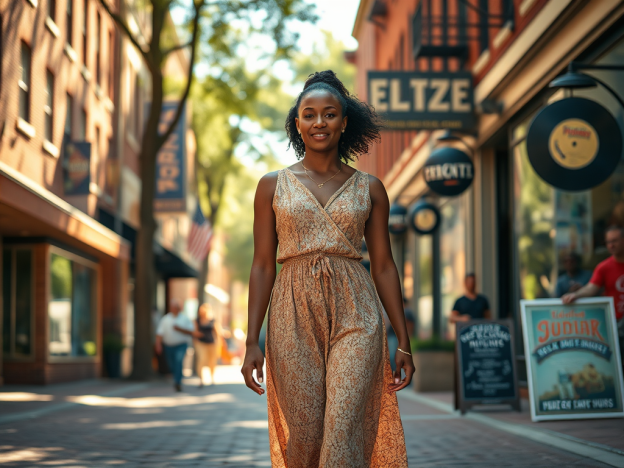
In July of 2024, the town buzzed with more than its usual energy. Eliza, a 21-year-old known for her stoic demeanor, drew attention. She had been born with a congenital limp. The slow, uneven gait defined her movements and her role in the town. Many admired her determination, while others pitied her struggle. Eliza worked at a small music store, organizing records and greeting tourists who came to see the city’s landmarks.

One day, Eliza disappeared from her usual spot. Her absence lasted for three days. When she returned, she walked differently. Her limp was gone. At first, only a few noticed. “Eliza, you seem… different,” said Mrs. Carter, a regular customer. Eliza’s response was simple: “Yes. I am.”

Word spread quickly. Some townsfolk were ecstatic. “A miracle,” declared Mr. Howard, the church deacon. “She’s been healed.”

Others were skeptical. “It’s a trick,” muttered a man at the bar. “People don’t just change like that.”

When pressed for answers, Eliza spoke cryptically. “I prayed differently,” she said. “It’s not something I can explain.”

The ambiguity only fueled speculation. Some believed she’d found divine favor. Others thought she’d undergone a secret surgery. The debate engulfed the town. CNN ran a short segment on the story, showcasing the split opinions. Macon’s streets, alive with history, now buzzed with arguments over Eliza’s transformation.

“You need to tell us how,” said Pastor Garrison during a Sunday service. “If it’s God’s work, the world should know.”

Eliza attended the service but said little. Her presence alone stirred unease. “Faith isn’t for display,” she finally said. Her words silenced the congregation.

Privately, Eliza kept a journal. In it, she recorded her prayers—structured sentences repeated at dawn and dusk. She’d found the method in an old book about ancient meditation techniques and hymns she’d grown up singing. It was her secret. She told no one, believing the practice would lose its power if shared.

One evening, Eliza visited the Ocmulgee Mounds. She walked the trails, feeling the weight of the earth beneath her feet. She knelt on the grass, her palms up. “Show me the way,” she whispered. To her, this was her true prayer—a connection to God, something beyond understanding.

The city’s divide grew. At a town hall meeting, Mayor Thompson addressed the issue. “We’re a community,” he said. “We celebrate each other’s triumphs. Let’s not tear ourselves apart over something we don’t fully understand.”

But the tension remained. Tourists began arriving, hoping to catch a glimpse of Eliza. Some sought blessings. Others wanted answers. “She’s hiding something,” accused a man from Atlanta who’d driven down just to see her.

The plot thickened when Dr. Morgan, a local physician, claimed she’d examined Eliza years ago. “Her condition was irreversible,” she said. “This defies everything I know about medicine.”

Eliza’s closest friend, Daniel, visited her one evening. “They won’t stop,” he said. “You’ve got to give them something.”

“I’ve given them all I can,” Eliza replied. Her tone was firm.

Daniel frowned. “Do you even know how this happened?”

“I prayed,” Eliza said again. “And I believed.”

As the month wore on, the community’s fascination began to wane. The bagel shop and the soul food restaurant drew crowds again. The music halls filled with laughter and song. Eliza continued her work at the music store, her steps steady.

In the final days of July, a letter arrived for Eliza. It bore no return address. Inside was a single sentence: “You walk because you let go.”

Eliza read it twice and tucked it into her journal. She knew the words were true. It wasn’t the prayers or the method. It was the act of releasing her fear and accepting the unknown. Her secret wasn’t in the prayer itself but in the shift it caused within her.

The surprise came not in Eliza’s transformation but in its ripple effect. Quietly, others in the town began to change. Small miracles unfolded. A man with chronic pain felt relief. A woman who’d been estranged from her sister made amends. People spoke more kindly. The community’s division over Eliza faded, replaced by something unspoken yet shared.

Eliza’s story became less about her and more about Macon—a town reconciling its past, finding healing in its present.