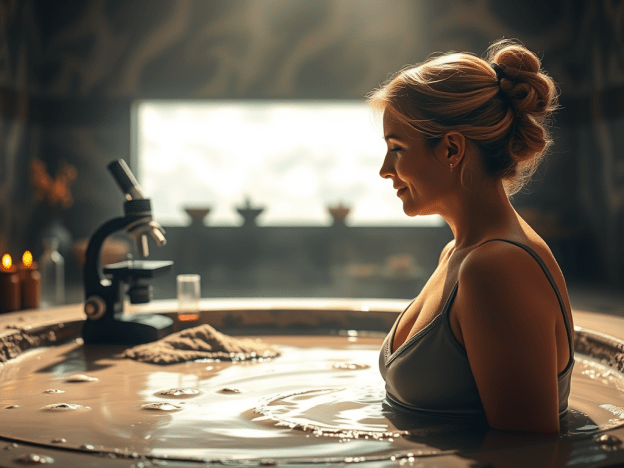
Champaign-Urbana, Illinois, is known for its sprawling university, strong ties to technology, and vibrant cultural scene. Its twin-city charm has attracted many ambitious minds. Among them was a young woman named Helen Hastings. She had grown up in Urbana, the quieter of the two cities, and recently graduated from the University of Illinois with a degree in biology. The story of Helen’s extraordinary year began with a visit to Crystal Lake Park on a crisp spring day.
Helen had heard about Serenity Spa, a wellness retreat near the park. It was gaining popularity for its unique mud baths, touted as “revitalizing” by locals. Helen decided to treat herself to a session, having recently landed a research job. Her parents, avid supporters of her pursuits, encouraged her to relax after months of grueling study.
The spa had a calming atmosphere. Customers sipped herbal teas while waiting for their treatments. Helen signed up for the signature mud bath and found the experience oddly soothing. The staff were friendly, and the setting was serene. She left feeling rejuvenated.
A week later, Helen felt unusually tired. Soon, she developed a fever and a persistent rash. Her physician ran tests but found nothing conclusive. “It’s probably a viral infection,” he said. Helen’s parents urged her to rest, but her curiosity gnawed at her.
“The spa seemed clean,” Helen told her friend Maya, a fellow biology graduate. “Still, I can’t shake the feeling that something wasn’t right.”
Maya shrugged. “If you’re that worried, go back and ask questions. Maybe you’ll find something interesting.”
Helen returned to Serenity Spa, posing as a curious customer. She asked about their mud source. The manager, an affable man named Greg, explained that it came from a local supplier. “We test it monthly for contaminants,” he assured her. Helen left feeling slightly embarrassed for suspecting anything.
Two months later, Helen overheard a coworker, Jake, discussing his recent visit to Serenity Spa. “Great experience,” he said, “but I’ve been sick ever since.” Helen’s ears perked up. She questioned him about his symptoms, which mirrored her own.
“I’m sure it’s unrelated,” Jake said. “These things happen.”
But Helen couldn’t let it go. This time, she took action. Armed with sterilized containers, she revisited Serenity Spa and discreetly collected samples of the mud. She mailed them to a former professor’s lab at the university, seeking help to analyze them.
The results came back two weeks later. The mud contained unusually high levels of a rare bacterium, Pseudomonas thermotolerans, known to thrive in warm, moist environments. It was harmless to most but posed risks to individuals with certain genetic markers—like Helen.
Her family rallied around her. “You should notify the spa,” her mother urged. Her father agreed. “But be tactful. They may not know about this.”
Helen arranged a meeting with Greg. She presented her findings calmly. Greg appeared genuinely concerned. “We’ll investigate immediately,” he promised. He thanked Helen for her diligence and assured her that the spa’s operations would be halted temporarily.
A month later, Helen received an unexpected call. It was Greg. “We found nothing wrong with the mud from our supplier,” he said. “Your results were an anomaly.”
Confused, Helen revisited her data. Everything seemed accurate. Meanwhile, reports of illnesses among spa visitors dwindled. Helen wondered if she had been mistaken.
Then came the twist. Helen’s mother, an avid gardener, mentioned something peculiar. “The compost I bought recently had a strange smell,” she said. Helen’s curiosity flared. She examined the compost and ran quick tests in her lab. To her shock, it contained traces of the same bacterium found in the spa’s mud.
Helen pieced it together: the spa’s mud supplier and the compost vendor were the same. A contaminated batch of compost had likely seeped into the mud used at the spa. Helen notified Greg, who immediately pulled all products sourced from the vendor.
The spa reopened months later with stringent new protocols. Greg invited Helen to their grand reopening. “Thanks to you, we’re safer now,” he said, offering her a lifetime membership, which she politely declined.
The year ended with Helen receiving a local award for community contribution. During her acceptance speech, she joked, “Who knew mud baths could be so educational? I’ll stick to bubble baths from now on.” The audience roared with laughter. Helen’s mother added, “And I’ll stick to planting flowers, not bacteria.”
Champaign-Urbana’s residents still talk about the time a young woman uncovered the mystery of the spa mud. Helen became a local hero—and an accidental advocate for better compost. The spa continues to thrive, and Helen’s story is a reminder that even small actions can make a big difference.
 Motivation E-Books