American Family in Alice Springs

Alice Springs, in the Northern Territory began as a small, isolated town.
Its people were hardy folk, used to the heat and the dry air. In 1954, Americans arrived. Not as tourists, but as residents.
Their base was set up outside of town as part of a joint American-Australian agreement. This brought American families into the heart of the desert, and slowly, Alice Springs began to change.

New customs arrived with them. Thanksgiving dinners became as familiar as Australian meat pies. Baseball games replaced cricket on weekends.
The children of Alice Springs grew up playing both sports, celebrating both the 4th of July and Australia Day.

By the 1970s, Alice Springs had transformed.
Pine Gap, the satellite tracking station southwest of town, brought in more Americans and jobs.
The town expanded. It was no longer just a remote outpost in the desert.
It had become an international community where Australian and American families lived side by side.

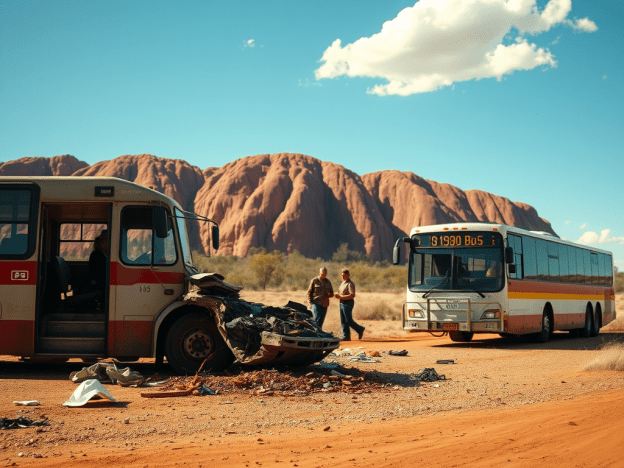
One American family lost their son in a crash with a bus.
The son and his friends were bored, so they decided to drive to Ayers Rock.
A tourist bus was coming in the opposite direction.
The bus driver took a corner too wide and hit the car.

The Grief of a Family

Judy sat at the kitchen table, staring at a photograph.
It had been two years since the crash. Her son, Adam, had been full of life.
Eighteen, with the world at his feet.
He had plans, dreams, things he wanted to do.
But all of that ended one rainy afternoon.
The bus had come around the corner too fast. It skidded, losing control, and smashed into Adam’s car.

The bus driver was at fault. The investigation said as much, but nothing happened.
He still walked the streets of Alice Springs.
Judy saw him at the market, at the post office.
Free, while her son was gone.

Her husband, Henry, couldn’t bear to look at the man.
Every time he saw him, rage bubbled up inside him, threatening to explode.
He’d grip Judy’s hand, tighter than he needed to, but she never said anything.
She understood.

One afternoon, they were sitting at the café.
Judy saw the bus driver again, walking down the street, laughing with a friend.
She watched Henry’s face harden. His fists clenched.

“He should be in jail,” Henry muttered.

Judy didn’t answer right away. She sipped her tea, looking out over the town square. “What would it change?”

“He’s walking free while our son is in the ground.” Henry’s voice was low, filled with pain.

“I know.” Judy placed her hand on his. “But anger won’t bring Adam back.”

Henry looked away, his jaw tight. “Then what will?”

There was no answer to that. Not one that made sense.
They had been asking themselves that question for two years. And in all that time, nothing had filled the emptiness that Adam left behind.

Weeks passed, and the town grew restless. People whispered about the tension between Henry and the bus driver. There were looks exchanged, and rumors spread. Some said Henry would confront the man. Others feared worse.

Judy sat down with Henry one evening. They were in their living room, the lights dim, the house quiet. She looked at him, really looked at him, and saw the weight he carried.

“I can’t live like this anymore,” she said softly. “It’s tearing you apart. It’s tearing us apart.”

Henry didn’t respond. He stared at the floor, his shoulders hunched.

“I’ve been thinking,” Judy continued. “We need to make peace.
Not for him,” she added quickly, “but for us.”
Henry scoffed. “Peace? How?
He’s still out there. Every time I see him, I want to kill him”

“I know,” Judy interrupted. “But we can’t keep living in anger. It’s killing us.
We need to move forward.”

Henry shook his head. “I can’t forgive him.”

“I’m not asking you to.” Judy’s voice was calm, steady.
“But we need to find a way to let go. For Adam’s sake.”

That struck a chord. Henry sat back, his eyes glistening.
“For Adam,” he repeated, his voice barely a whisper.

Judy reached out and took his hand. “I’ll make you a bargain,” she said.
“We’ll try. We’ll do it together. But if it’s too much, we’ll walk away.
No shame. But we have to try.”

Henry nodded, though reluctantly. “Alright,” he said after a long pause. “For Adam.”

Months later, Judy was in the town square when she saw the bus driver again.
But this time, he wasn’t laughing. He was handing out fliers, speaking quietly to a small group of people.

Curious, she approached.
The flier in his hand read: “A Memorial Fund for Adam”.
The bus driver caught her eye, and for the first time, his expression wasn’t one of indifference. It was sorrow.

“I did the wrong thing,” he said quietly.
“But maybe I can do the right thing and help others.”

Judy stood there, surprised, not knowing what to say.
The anger she had held onto for so long suddenly seemed lighter.
Maybe, just maybe, there was a way forward after all.


Republican Party and Democratic Party Compromise.

Crescent River was founded in 1720 by French settlers, who were soon followed by Spanish missionaries. The town sat at a bend in a wide, shimmering river, giving it the name Crescent River. Native American religions, and Christianity mixed in unexpected ways. Rituals would blend Catholic hymns with the rhythmic drums of the faiths. Spanish priests walked through the streets, while local people continued their traditional practices under the moonlight.

By 1800, Crescent River had grown into a bustling trade port. French, Spanish, and British settlers fought over control, each leaving a mark on the town’s culture. The town became a melting pot of languages, beliefs, and traditions. A small Catholic church stood in the town square, next to a Protestant meeting house. On weekends, the streets filled with both worshippers and street vendors, all moving in harmony. Christianity dominated the religious landscape, but echoes of older faiths still lingered in whispers.

In the early 1900s, Crescent River was a thriving place, known for its riverboats and agriculture. Farms grew along the fertile riverbanks, bringing wealth to a few, while many toiled in the fields. The town saw many shifts in its leadership as the United States grew. Other Christian denominations, like Southern Baptists and Methodists, were also present, but they stayed small in the shadow of the town’s Catholic roots.

As the 20th century continued, Crescent River became a center for political debate.
It was a place where community and personal beliefs often collided.

The Political Dispute

By 2020, Crescent River was still a quiet town, but one couple caused quite a stir: Emily and John Delacroix. They lived in a modest house on the riverbank, and though they were well-liked, their recent political decisions worried everyone.

Emily had begun to promote the Republican Party. She passed out flyers, attended rallies, and even organized small gatherings at the town hall. John, her husband of 25 years, was a lifelong Democrat. He would attend local Democratic meetings and hang campaign posters on their front porch. Soon, their house had become a battlefield of political banners.

The townspeople didn’t know what to make of it.

“John, you’ve gone and done it again,” Emily teased one morning. She was pouring coffee at their kitchen table, pointing to a new Democratic sign on the lawn.

“Well, Em, I had to. Can’t have the neighbors thinking we’ve lost our senses,” John said with a grin.

Emily laughed. “I think they’re more worried about us, not our signs.”

The political tension between them amused the couple. Yet, it began to make others nervous. Neighbors whispered at church.

“What will happen if Emily and John really start fighting? It could divide the town,” one woman murmured in the pews.

Despite the townspeople’s fears, the couple carried on as usual. They laughed at each other’s debates and even helped one another prepare speeches. Emily handed John notes before his Democratic club meetings, and John gave Emily pointers on her public speaking at Republican events.

But one evening, after a particularly heated election season, Emily brought up something that had been bothering her.

“John, we need to talk,” she said as they sat on their porch.

“About what, Em?” John asked, leaning back in his chair.

“This. Us. The politics. We’re pulling people apart,” Emily said quietly.

John smiled, a bit sad now. “I’ve been thinking the same.”

They sat in silence for a moment, listening to the river’s quiet flow.

“We need a deal,” Emily finally said. “How about… we make a bargain. No more public campaigning. We can have our beliefs, but we won’t pull the town into it.”

John nodded. “Agreed. But… what’s the catch?”

Emily grinned. “Well, I want one thing in return.”

“What’s that?”

“You help me set up a charity for the community. Something we both agree on. We’ll still be involved, but in a way that unites, not divides.”

John laughed, his mood lightening. “That’s a fine idea, Em. But I have a condition too.”

Emily raised an eyebrow. “Oh? What’s that?”

“You have to admit, just once… that the Democrats have better coffee at their meetings.”

Emily laughed out loud. “You wish!”

They both chuckled, but Emily winked. “Fine. Once. But only after you admit the Republicans make better pies.”

John smirked. “Deal.”

The Surprise

The next morning, the town buzzed with news. The Delacroix house no longer had any political signs. Instead, a large banner hung across their porch: “Crescent River Charity – Bringing Us Together.”

As Emily and John worked on their new project, the townspeople breathed a sigh of relief. They had feared the worst, but instead, they got something far better—a community united.

And when the charity opened its doors, John and Emily were behind the counter, side by side, serving pie and coffee. The real surprise? Both tasted equally delicious.

Marrriage and Longreach Queensland

Longreach had a humble beginning. It was a town built on dreams of open skies and endless possibilities. The red and white livery of the Qantas jumbo jet stood as a reminder of the town’s significant place in aviation history. The Qantas Founders Museum celebrated those early days, when pilots navigated uncharted skies, turning Longreach into the birthplace of Australia’s national airline. Across the road, the Australian Stockman’s Hall of Fame paid tribute to the rugged stockmen, explorers, and pastoralists who tamed the harsh land, making Longreach what it is today.

One of those stories started with Beth and her husband, Joe. They were well-known in town. Joe ran the local sheep station, Camden Park, which had been in his family for generations. He was practical, quiet, and deeply respected by everyone. Beth was the opposite—warm, talkative, and always curious. They’d been married for twenty years. Beth loved Joe, but she always had a restless spirit. While Joe stayed on the land, Beth was drawn to the skies.

Beth often visited the Qantas Museum, wandering through the halls, reading about the pilots and their daring flights. One day, she met Tim, a local pilot. He was friendly, and they struck up a conversation. Tim had an easy smile and a deep passion for flying. It didn’t take long before their chats turned into regular meetups. Sometimes they’d talk over coffee at the museum, other times they’d walk along the Thomson River, watching the golden glow of the outback sunset.

The town began to whisper. A married woman spending time with a younger man—a pilot, no less—was bound to raise eyebrows. Joe heard the whispers too. He wasn’t one for gossip, but he noticed Beth was spending more time away from home. He wasn’t sure how to bring it up. He trusted Beth, but trust wasn’t enough to silence the talk in town.

One evening, Joe sat on the porch, staring out at the fading light. Beth joined him, quietly taking her seat. The silence stretched between them, thick and heavy. Finally, Joe spoke.

“I hear people are talking.”

Beth sighed. “I know. But Tim is just a friend, Joe.”

Joe nodded slowly, choosing his words carefully. “I’m not worried about him. I’m worried about us.”

Beth looked at her husband, her brow furrowed. “I don’t want you to think there’s anything going on. He’s a good man, but that’s all it is. Friendship.”

Joe thought for a moment. “Maybe. But people see what they want to see. And I’ve been wondering if maybe I haven’t been paying enough attention to what you need.”

Beth looked at him, surprised. “It’s not like that. I just like talking to him. He understands things…flying, the freedom of it. You know how I feel about the skies.”

Joe sighed. “I know. But we live here, on the ground.”

They sat in silence again, both deep in thought. After a long pause, Beth spoke, her voice soft but steady. “I love you, Joe. I’ve always loved you. But I need something more—something that makes me feel alive.”

Joe’s eyes softened, and he nodded. “I get that. I can’t give you the skies, but maybe we can find a way.”

The next morning, Joe suggested a bargain. He knew Beth craved adventure, and while he couldn’t change his nature, he could offer her something new. “How about this,” he said, “you can fly, but we do it together. Let’s learn more about this place, together.”

Beth was taken aback. “You’d do that?”

“I would,” Joe said simply. “For you.”

And so they did. Together, they explored the outback in new ways. They took sunset cruises on the Thomson River, learned the stories of the stockmen at the Hall of Fame, and even visited Strathmore Station for the Smoko Tour. Joe even agreed to step onto a jumbo jet wing at the Qantas Founders Museum. Beth’s face lit up, but the real surprise came when Joe revealed his plan.

“I’ve been talking to Tim,” Joe said one evening after they returned from the river. “He’s agreed to give us flying lessons. Both of us.”

Beth stared at Joe, her mouth open in shock. “You? Flying?”

Joe shrugged. “I figure if it’s what you love, maybe I can learn to love it too.”

Beth couldn’t help but laugh, her heart full. The town might have been worried about her friendship with Tim, but in the end, it brought her and Joe closer. As they flew together over Longreach, the land below stretched out, vast and endless, much like their future. The skies were no longer just Beth’s escape—they were part of their story now.

The whispers in town faded, replaced by something stronger: a quiet respect for the couple who found a new way to soar, together.